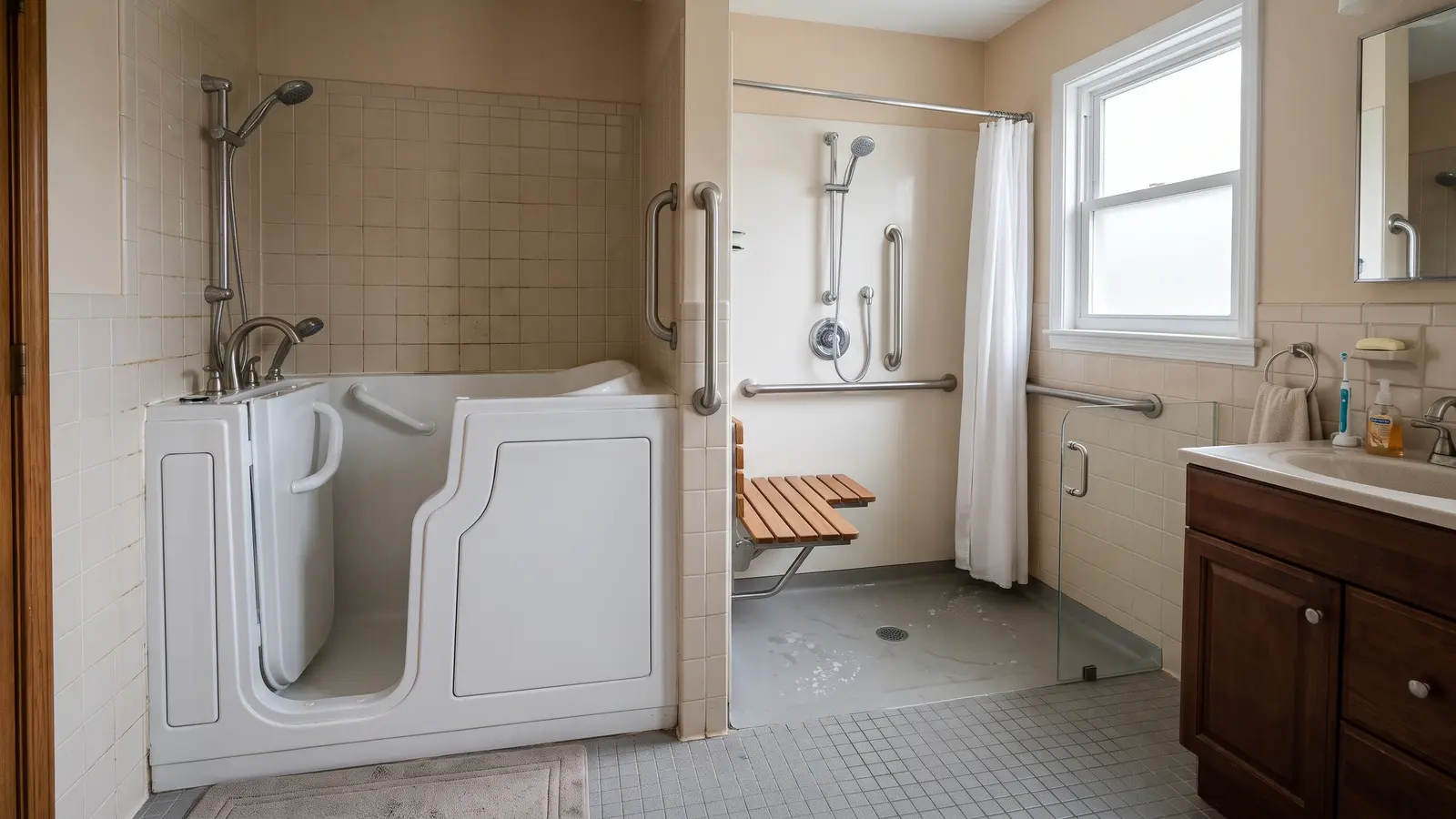
Walk-in tub vs. walk-in shower for aging in place
When getting in and out of the tub gets harder, most Fort Wayne families look at two options: a walk-in tub with a door, or a walk-in shower with a low entry. Both improve safety. They're very different to live with day to day, so here's an honest side-by-side.
Get a Free Quote
Fast. Easy. No obligation.
Quick answer
For most people planning to age in place, a low-threshold or curbless walk-in shower with a seat and grab bars is the more practical choice: it costs less, is quicker to use and is easier to clean. A walk-in tub makes sense mainly for people who truly want to soak, for example for joint or muscle pain.
Option A
Walk-In Tub
A deep tub with a watertight side door and a built-in seat, so you step in without climbing over a tub wall and sit to bathe.
Option B
Walk-In Shower
A shower with a low threshold or no curb at all, typically with a bench or fold-down seat, grab bars and a handheld shower.
| Walk-In Tub | Walk-In Shower | |
|---|---|---|
| Typical cost in Fort Wayne | About $9,000–$20,000 installed | About $8,000–$18,000; accessible remodels $10,000–$30,000 |
| Getting in | Small step through the door (usually a few inches) | Low threshold or none; can be wheelchair accessible |
| Fill & drain time | You sit inside while it fills and drains | None; turn it on and go |
| Soaking | Deep, seated soak; jets on some models | No soaking |
| Water heater | May need a larger water heater to fill it | Works with a normal water heater |
| Cleaning | Door seal, seat and jets to keep clean | Walls, floor and glass to wipe |
| Caregiver help | Harder to assist someone inside the tub | Easier: room to stand beside the seat |
| Best for | People who love soaking or use it for pain relief | Most aging-in-place and mobility needs |
The part nobody mentions: fill and drain time
A walk-in tub's door has to be closed before you fill it, and it can't be opened until the water has drained. That means sitting inside while the tub fills, and again while it empties, which can feel chilly in a Fort Wayne January. Fast-drain models shorten the wait, but it's still part of every bath. If you mostly want to get clean quickly and safely, that time adds up.
Deep walk-in tubs also hold a lot of water. Some households need a larger or faster water heater to fill one with hot water, which can add to the project cost. We check this during the walk-in tub estimate.
Safety and mobility
Both options remove the riskiest move in a standard bathroom: stepping over a high tub wall on a wet surface. A walk-in shower goes further for most people. A curbless design with a linear drain means there's nothing to step over at all, and it can work with a walker, shower chair or wheelchair. With a fold-down seat, grab bars where they're actually needed and a handheld shower on a slide bar, many people can bathe independently for years longer.
A walk-in tub still requires stepping through a door and lowering onto a seat, then standing up from it. For someone with good balance who wants to soak, that's fine. For someone with limited mobility or who uses a wheelchair, a shower is almost always the better answer. Our accessible bathroom projects are built around these details.
Cost compared
In the Fort Wayne area, a walk-in tub typically costs $9,000–$20,000 installed, depending on the model, jets and any plumbing or water heater changes. A walk-in shower usually runs $8,000–$18,000, and a fuller accessible remodel with a curbless shower, wider door and comfort-height fixtures is about $10,000–$30,000. If budget is tight, a tub-to-shower conversion with a low-threshold base, seat and grab bars ($6,000–$14,000) delivers most of the safety benefit for less.
Thinking about resale
A well-designed walk-in shower appeals to almost every buyer. A walk-in tub appeals to a narrower group. If you might sell in the next few years, the shower is usually the safer investment, and keeping a standard tub in another bathroom covers families with children.
The verdict
Choose a walk-in shower if the goal is safe, quick, independent bathing, if a walker or wheelchair is involved now or likely later, or if a caregiver helps with bathing.
Choose a walk-in tub if soaking genuinely matters to you, for comfort or pain relief, and you're comfortable sitting in the tub while it fills and drains. Either way, we'll measure the space and walk you through both in a free visit.
Related services
Questions people ask
Are walk-in tubs worth it for seniors?
For people who truly want to soak, they can be. For most people focused on safety and ease, a low-threshold walk-in shower with a seat and grab bars is simpler, faster to use and usually less expensive.
How much does a walk-in tub cost in Fort Wayne?
Typically $9,000–$20,000 installed, depending on the tub, features like jets, and whether the plumbing or water heater needs upgrading.
Will Medicare pay for a walk-in tub?
Original Medicare generally treats walk-in tubs as home modifications rather than covered medical equipment, so it usually doesn't pay. Some Medicare Advantage plans, VA programs or local aging-services agencies may help; check with them directly.
Can a walk-in shower work with a wheelchair?
Yes. A curbless (roll-in) shower with a linear drain, a fold-down seat and grab bars is built for that. See accessible bathrooms.
Do walk-in tubs leak?
The door seal is the part to watch. Quality tubs installed level and maintained according to the manufacturer seal well, but the gasket needs to be kept clean and checked over time.
Don't Put Up With a Bathroom You Hate.
A tired, leaky or hard-to-use bathroom only gets more expensive to ignore. Get a free, written quote and a real plan.
- Calls answered 24/7
- Free, written estimates
- Fort Wayne & nearby